A Sad and Watery End for English Stockman Joe Taylor

POMMY JOE TAYLOR was a bushman from the UK, a loyal and capable stockman, and a likeable, knockabout bloke. Born in Yorkshire, England in 1923, Joe travelled further than most Englishmen seeking excitement and solitude in the western Queensland bush, shortly after the end of WWII. Little is known about Joe’s life before he arrived on Gwambegwine Station, Taroom, except that he had a sister living in Yorkshire.

Laurie pointing, a ringer from 1952-1958 spoke of the years he spent working on the stations around Taroom, immediately before signing up to the Queensland Police force, a career change inspired by Sergeant Jim Johnson of Taroom Police. Sgt Johnson raised the question with Laurie about what he would do if he were to find himself injured, knocked around from working as a stockman. He asked Laurie if he had ever considered a career in the police force, given that Laurie was such a big, strapping lad, and that Laurie’s older brother Tom had already joined the police in Ipswich?

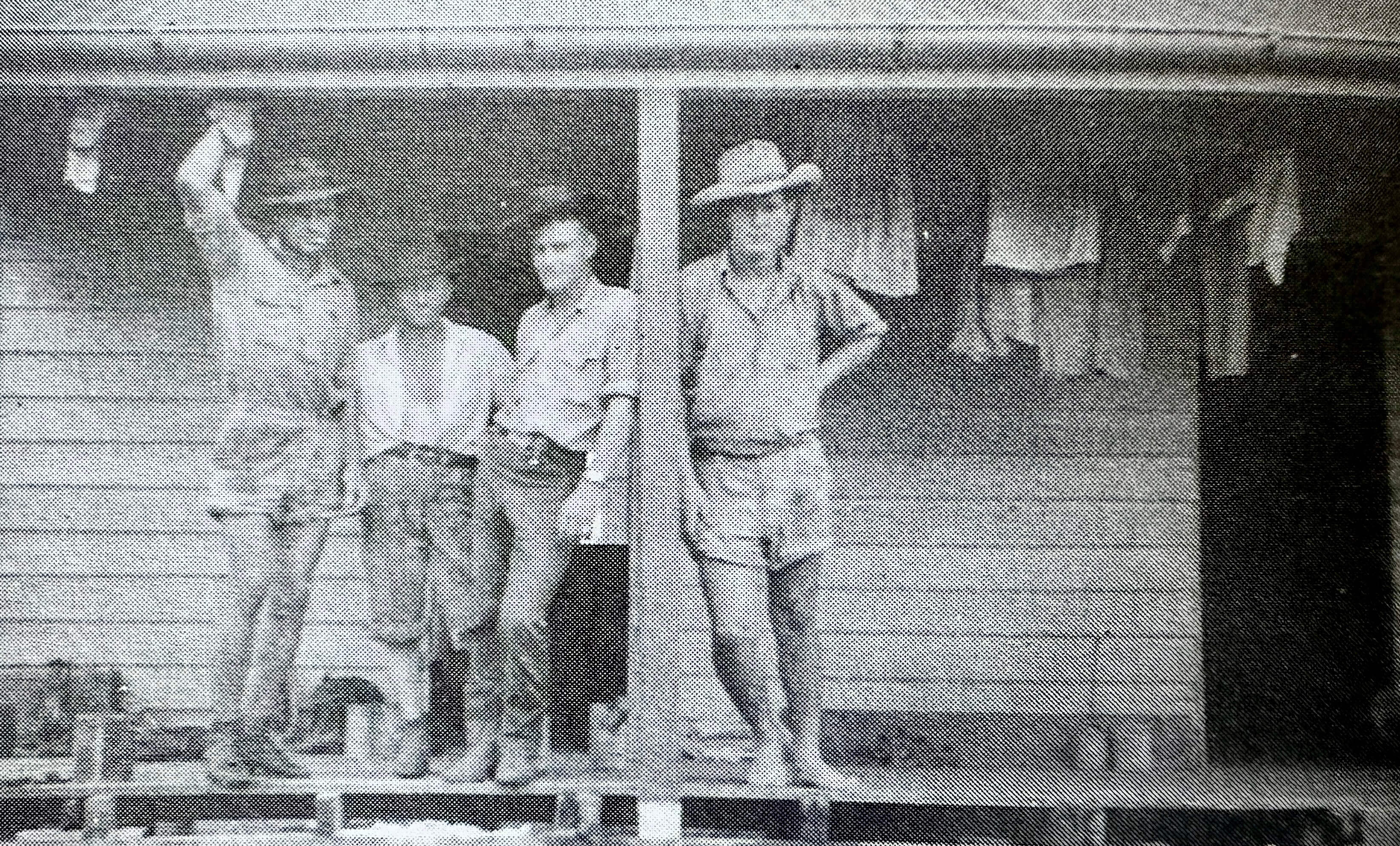
One of the first encounters Laurie Pointing had with Sergeant Jim Johnson was while he was working with older stockmen (pictured above) during the 1954 floods at Gwambegwine. He wondered if I had ever heard the tragic story of his stockman mate Joe Taylor?
Laurie Pointing, from Raceview, Ipswich
Laurie Pointing had arrived in Taroom from Ipswich a few years earlier, in March 1952, when he was just 15 years old. He first worked at Nunbank and Broadmere stations before moving on to Gwambegwine. Laurie was 17 when he and Joe Taylor worked together in 1954. To young Laurie, Pommy Joe was an “old man” of 30 with 4 years of experience as a stockman on Gwambegwine with Manager Doug Day.
Doug was from New Farm, Brisbane and was born in 1923, the same year Pommy Joe Taylor was born in Yorkshire, England. Doug was a 19-year-old Jackaroo when he enlisted as a pilot in WWII, flying Tiger Moths, Ansons, Oxfords, Wellingtons, and Lancaster planes.
Joe Taylor, from Yorkshire England
Taught the ways of an Australian stockman by fellow ringers, Joe Taylor was liked by all who knew him. As Laurie recalls, Joe wasn’t a drinker, and even though he would join in the fun when the stockmen were in town, he was never associated with trouble. Joe had a reputation with his colleagues of always trying to please the boss, rather than joining his larrikin Aussie mates in their unruly ways. Some of the men he worked with harboured unsubstantiated suspicions of Joe “dobbing to the boss” based solely on his loyal nature to his employer, Doug Day. It’s more likely that at 30 years of age he was a bit more sensible than the young ringers, and that Joe always wanted to do the right thing by Doug.

It was unusual for a stockman to stay on one station for such a length of time in those days, an indication of either Joe’s faithful nature, or perhaps that he was just happy with his lot in life at that point in time.
“Pommy Joe was a good bloke, very loyal to Manager Doug Day, and a pretty good stockman… for a Pom!”
Laurie Pointing 2024, Colleague of Joe Taylor, Gwambegwine 1954
The Big Flood – February 1954
The year was 1954. The country around Taroom had copped substantial rain in January, followed by falls of 19 inches early in February recorded around the Palm Tree and Robinson Creeks, with similar rain falling all around Taroom districts. The muddy waters of the Dawson swelled, banks broke, and Creeks were flooded everywhere. Stations supplies were running low, roads were cut, and telephone party lines were down, cutting communications to town. Landowners were stranded with no choice but to sit it out.
Alwyn Becker was the popular mail contractor for Gwambegwine, always ready to help however he was able.
The extent of the 1954 flood, that reached up the front steps of the Leichhardt Hotel in Taroom, is best explained in Alwyn’s memoirs, “The Mail Must Get Through”. An extract follows about the 3 weeks immediately prior to the Gwambegwine tragedy, when his Mail run to Stonecroft took more than 2 weeks (it usually took 3 days). [Reprinted with kind permission of Vaughn Becker]
Alwyn writes, “In February 1954, the Dawson River and all its tributaries were in high flood after very heavy rains. I was ahead of the water going out on the mail run, but the return trip was quite a different experience.
I arrived at Burnley where Mrs [Bill] Gunnourie expressed concern about whether I would reach Taroom. She very kindly filled my tucker box with meat, bread, tomatoes, cucumbers, cake and biscuits and I left for Taroom via the Sandy Road so I could bypass the Palm Tree Creek crossing at Wythburn.
I reached the Palm Tree Creek bridge near Steffensen’s property, Palm Vale, to find a vast expanse of floodwater with no bridge in sight. Palm Tree Creek and Robinson Creek had become roaring torrents.
I parked my Jeep truck on a high ridge and, taking my return mail and provisions, I walked to Palm Vale homestead where I was made very welcome, as were my food supplies. Although the floodwaters were close to the house, we made frequent trips to monitor the rising waters as more heavy rain poured down and the gullies and creeks rose and fell with the successive downpours.
Those present at Palm Vale were Bardy and Stan Steffensen and their son Ian. Their neighbour Bill Joynson called in every day. After about ten days, others arrived: Charlie Clark, Jack Clarris, and Dick Williams. I had with me a portable ex-Army telephone which I carried in case of emergency, and for testing the party lines for faults, which were common.
Because of my testing method the station people could go straight to the fault and repair it. Using my phone I was able to contact [my wife] Joyce in Taroom and she could take messages to the Post Office, the Council, and Police so they knew the situation. When the Army phone could no longer push the current through, Joyce would ask the telephonists to plug in her call “on the hour” and I would wait until we made voice contact. We did this until the phone lines at Stony Crossing on the Dawson River went under water and cut the connection. I later gave the old army phone to [my son] Vaughn when he restored his Willys 4-75 truck.
I went down to the flood about 11 o’clock one morning and I was watching the water bounce off the tree trunks, when I thought I heard voices, so I hurried back to the house and told them the boat was coming. We all set off to meet the rowboat which had Sergeant Jim Johnson, Bloko Adam, and Mick Standing on board. They also brought supplies. They told us the Council motorboat had towed the rowboat from Taroom to the Three Mile Hill where Charlie Turner of Alkoomie loaded the boat onto his Blitz truck and took it to Cattle Creek. They launched the boat there and rowed to where the Palm Tree Creek bridge was submerged on the Theodore Road where we were waiting.
As the boat party prepared to leave, another burst of rain teemed down. Sergeant Johnson, Bloko Adam, Mick Standing, Charlie Clark, Jack Clarris, Dick Williams, and I [Alwyn Becker] were on the boat.
The current was so strong it would wash the boat up against the trees and the boat was taking water over the sides.
Those who could, desperately put their arms around the trunks and held the boat while Jack Clarris frantically bailed.
I have never been able to swim. I told Sergeant Johnson this after we got to town and he said, “If I had known that you would never have got in the bloody boat.” Just as well I had not told him.

The waters were so high, I crouched in the front of the boat and caught the telephone lines as we approached them and tossed the wires back over the boat and the other men. We reached Cattle Creek and moored the boat to a guidepost on the main road.
We set off to walk to Charlie Turner’s and on arriving there we saw Charlie working to stop his dam from washing away. We all grabbed shovels and turned the water away from entering the dam and saved the situation. Charlie then drove us to the Three Mile Hill where Sergeant Johnson had asked the Council to have the motorboat waiting for his return in the late afternoon. However, the Council decided it was too late and dangerous for the boat to come out and return before dark.
Pat and Edna Mohr fed us and supplied dry clothes and put us up for the night. In the morning, the motorboat ferried us to Taroom, where I finally delivered the mail to the Post Office. My vehicle stayed for three weeks on the hill where I left it before I was able to retrieve it.
At this time the roads were particularly bad due to heavy rain and floods and one of the Post Office Inspectors said that it was a wonder anyone could take a truck through, let alone maintain a regular [mail] service.”

Alwyn and the rest of the boat crew were lucky to arrive safely back in Taroom after that significant ordeal. Imagine the scene when Sergeant Johnson, hitching the boat, thinking the worst was behind them, was met by Constable Fred (Ted) Warner with an urgent message from Gwambegwine:
“Police presence requested immediately – a stockman has drowned in Gwambegwine Creek!”
The boat was relaunched without hesitation, with Sergeant Johnson, Constable Warner and JP Mohr (either John or Pat) returning back up the river to offer their help.

A STOCKMAN DROWNED – 13 February 1954
Witness Account retold by Laurie Pointing, 70 years later
“Party Lines were down after substantial downpours, and Gwambegwine station had lost communications to town. After weeks of significant rainfall, supplies were getting low.”
Having fixed the broken phone lines a few days earlier, Bob McCorry (25) and English stockman Joe Taylor (30), together with 17-year-old ringer Laurie Pointing, were sent out by Manager Doug Day to repair the party line again. It was considered an easy job, given they had already found a good solid place to cross the swollen river the first time.
Bob McCorry, the most experienced stockman and good mate of Doug’s, crossed first. As he entered the flooded Gwambegwine creek, Bobs horse floundered, dropping into a deep washout mid-stream, the mare lurching forward as she struggled to find footing. Bob leapt off into the water and swam across to the nearby bank. Waiting to cross after Bob, Joe Taylor caught Bob’s horse as it doubled back, leaving Bob stranded on the other side.
Joe Taylor entered the creek without concern, leading Bob’s horse over to him. Laurie Pointing was waiting on the bank, watching events unfold.
Neither Joe’s horse nor Bob’s horse (that he was leading) were keen on entering the creek, but he forced them forward, following the course they’d taken through the crossing the day before. Unbeknown to any of the men, the heavy rain overnight had gouged a deep channel in the solid crossing they’d used that previous day.
Near the middle of the crossing, with Joe distracted while coaxing Bob’s horse to keep up, the bottom of the creek dropped away below them. Joe’s horse panicked, floundering desperately, rearing high and bounding through the raging torrent. Bob’s horse pulled away wildly and Joe was thrown into the turbulent water, hooves striking the stockman as his rattled stockhorse lunged forwards… and Joe disappeared from sight.
That was the last time Laurie would see his friend Joe Taylor alive.
It’s all a blur from that point for Laurie. He recalls racing back up to the homestead to alert Doug Day, and the fruitless search along the creek bank praying that Joe had somehow managed to make it to shore downstream.
At some point Bob McCorry must have ridden on to a neighbouring property to raise the alarm and get word of the tragedy into town; or perhaps he managed to ride ahead and fix the party line that was down.
By the time Sgt Jim Johnson, mailman Alwyn Becker and the crew aboard the council boat arrived in town the following afternoon, the message from Gwambegwine had been delivered and Constable Warner was already preparing for their return trip.
Creeks and gullies were still flowing strong. All roads to Gwambegwine were impassable by vehicle, the terrain sodden and boggy.
Laurie recalls Ronnie Kallquist arriving with the authorities, and he assumes that a lot of work had been done by Ronnie to help get them there so quickly. Horses and supplies would have been organized by Ronnie and neighbours along the way. Extra men from the district who were able to make it on horseback joined the search party, but they were unable to locate the missing stockman.
Before returning to town, a net was cast across the creek, not far downstream from where Joe was last seen, with the view that he may still be trapped in tree roots below the surface.
John Hay recalls his older brother Duncan, still a teenager himself, helping with the search. Laurie confirms that Duncan was there some days later when Joe’s body was eventually found, caught up in the netted trap set by the police.
“I’ve never seen a man’s face as white as Duncan’s when he returned home with my father that day.”
John continued, “Duncan never spoke of that experience or the dreadfulness of what he saw, but once, years later, we were pulling a dead cow from a bog, and I was complaining about the smell. He commented that the stench was nothing compared to that of a decomposing human body.”
It had been 5 days since Pommy Joe Taylor had fallen into the creek.
Joe Taylor was wrapped in the net that caught him and carried back to Gwambegwine homestead where he was buried in the station cemetery – on the banks of the creek that took his life.

Laurie recalls little of Joe’s burial, except that he was buried in the clothes he was wearing, wrapped tightly in the police net in which he was caught.
It was too wet to cut timber to make a coffin.
The sombre stockmen (Bob McCorry, Max Archilles and Laurie Pointing) stood stoically, hat in hand graveside while Manager Doug Day, a man of few words who had known Joe the longest, spoke quietly about their workmate lost. The short service was officiated by Sergeant WJ Johnson (Jim). Constable FG Warner (Ted) and JP Mohr (John) were named as witnesses to the burial on Joe’s death certificate.
A twist in the tale… BOB McCORRY’s story
Overseeing the investigation into Joe’s death, Sergeant Johnson and Constable Warner took witness statements from the stockmen, leading to an unrelated, interesting twist in this tale…
Having completed his official duties, Sergeant Jim Johnson quietly beckoned Bob McCorry aside, out of earshot of the men and especially his diligent constable FG (Ted) Warner. At the back of the workmen’s hut the sergeant instructed Bob to roll up his trouser leg, where he saw a distinguishing mark or scar. Satisfied with what he’d seen, Jim declared, “I knew it was you!” before cautiously explaining to Bob what he now knew to be true.
Relaying the story in confidence to his trusted workmates later, Bob’s secret has remained with those few men for the rest of his life. At 69 years, while living in south-west W.A. in 1998 Bob McCorry passed away from cancer of the pancreas. It is now safe to tell his story.

“I had a lot of time for Bob McCorry, he was a really good, likeable bloke.” Laurie Pointing
After the police left Gwambegwine following the burial of Joe Taylor, Bob told Laurie that he’d once been a sailor in the Royal Australian Navy. Following in his older brothers’ footsteps, he signed up in January 1952 for a period of 6 years. He was 22 years old, and he detested the Navy with a passion. He had to get out.
It’s unclear how much time Bob had served when he made the decision to run away, making his way from one of the southern ports to Springsure in Central Queensland where he soon found work at Manchuan Downs. Whilst drinking at a Pub in Springsure with his stockman mates, he was spotted by a sailor from the same ship he’d fled. Shortly after, he was arrested by Warrant Officers who’d been sent from Sydney to bring him back for trial.
It was a long train ride to Sydney and the officers were bored and keen for a drink. Now, according to Laurie, Bob was a very likeable bloke, and he could drink rum like none he’s seen before or since. It wasn’t long before Bob was shouting drinks all round and getting on famously with his captors. By the time they arrived at the harbour down south the officers’ judgement had been impeded significantly and Bob was still as fresh as a daisy. He gave them the slip.
A handwritten note on Bob’s navy records, under Warrants, states that he “broke away from escorts 26 Dec ’53…” The warrant was noted “unserved”.
Making his way back to Queensland, Bob arrived at Gwambegwine where his good friend Doug Day just happened to be Manager. It was here that Sgt Jim Johnson caught up with him, having seen his name amongst the list of Australia’s Most Wanted in the weekly Police Gazette that circulated around the country. A scar on his right shin was the identifying mark that confirmed his identity.
Sgt Johnson was a popular officer in Taroom, firm but fair, and he knew a good man from a bad one. Perhaps feeling sorry for the 25year old stockman who had just witnessed one of his mates drowning, and knowing that Bob wasn’t one to ever cause trouble in town, he gave Bob a break, telling him: “Not to worry Bob, Constable Warner will never find out, I’ve kept the Gazette from him. Providing you keep your nose clean and stay out of trouble, your secret will be safe with me. They’ll never catch up with you.”
And to my knowledge, they never did. Bob continued to live and work as a stockman and Manager for the remainder of his life.
At some stage Bob moved north, eventually relocating to The Kimberley’s in WA where he met and married Sheryl in Derby 1973 when he was 44. Sheryl was 20 years younger. She published a book “Diamonds and Dust”, documenting their 25 years until Bob’s passing in 1998. There is no mention of Bob’s Navy history, nor his record as a “Deserter”.
I suspect the only ones he told were those at Gwambegwine the night of Joe Taylor’s funeral.

Years later, Laurie Pointing revisited Gwambegwine and was distressed to find an unmarked grave for his stockman mate Pommy Joe Taylor. Locating a death certificate, he found details for Joe’s sister, Gladys Irene Bird, and an address: 23 Saint John Street, Bridlington, Yorkshire, England. He gathered up all he could find on Joe Taylor – photographs, recollections, clippings, poems, etc. and sent them off to that address. To this day, he has never received a reply.
It’s difficult to imagine the impact of such a distressing event on those stockmen, with no such thing as counselling to help counter the mental anguish they must surely have suffered. I have no doubt they carried the memory of their mate Joe and his sad demise on their travels through life.
RIP Gwambegwine Stockmen of 1954:
Joseph William (Joe) Taylor 1923-1954 (30)
Robert Edward (Bob) McCorry 1929-1998 (69)



Leave a Reply