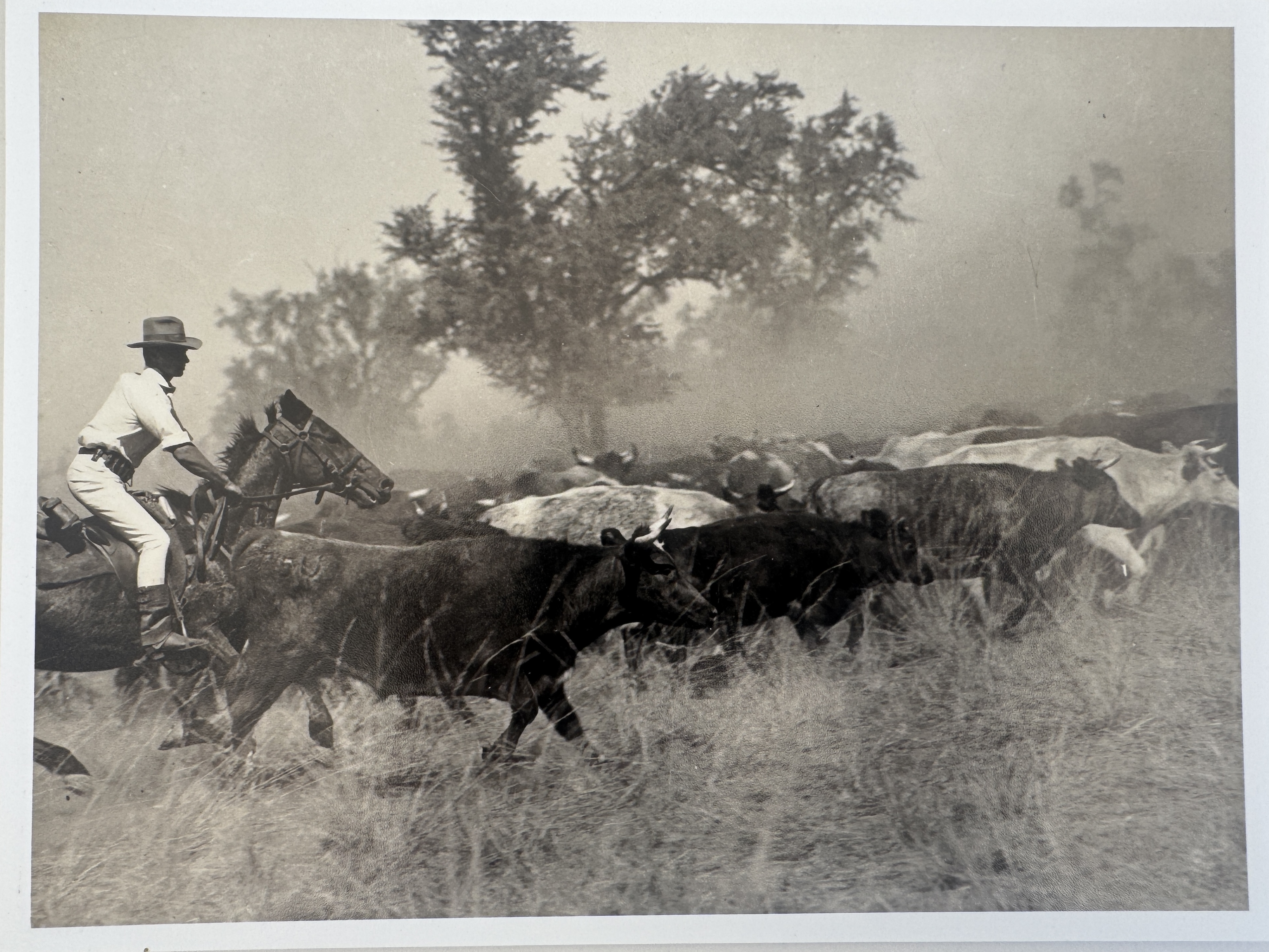
Remembering JIM BOOTHE, born 100 years ago on 8 May 1926 at “Boxvale” Injune, the respected 1950s Glenhaughton head stockman who passed away aged 50 years at “Reedy Creek” Taroom on Anzac Day 25 April 1975.

Born James Arthur Boothe, Jim grew up a bush boy. Second son of Harry and Violet Boothe, Managers of Boxvale Station, Roma. Jim was always happiest on the back of a horse. He was riding unassisted by the age of 2, and there wasn’t an animal that he couldn’t train to his satisfaction.
Older brother Mick was sent to boarding school in Brisbane, but Jim and sister Betty had bush in their blood and they opted to stay home at Boxvale, helping their elderly father with whatever work was going. In age, and spirit, Betty and Jim were very close. Betty named her only son James (Jim) after her adored younger brother, and her daughters Kay and Carol idolised their country uncle.

“Jim Boothe was a notable horseman, stockman, and bushman. He broke in a lot of young blokes and they were better men for it. He didn’t just show men how to work; he taught them about manners and respect as well.”
-Lex Smith, ex-Glenhaughton Ringer (1957-1960)
Those men who proudly worked under Jim Boothe have always spoken highly of the Glenhaughton head stockman who treated them more like his sons than young ringers. He was a notable horseman, stockman, and bushman. He led by example, passing on his vast knowledge and skills, which included resourceful animal husbandry – often saving injured dogs and horses with just a pocketknife and hair from the horses tail (used to stitch up a gored horse, or to make a splint for a dog’s broken leg). The animals he treated nearly always survived. He taught the men to give an injured animal a chance before rushing to put it down.
Bush Tracker skills once saved a lost and bady injured man at Reedy Creek
Jim was a master of leatherwork and bush tracking, skills he learnt from his father growing up, which he perfected in the Territory. He once tracked and saved a badly injured man who was lost for days in remote bushland on “Reedy Creek”, with no clue to his whereabouts.

By the 1950s Glenhaughton was well known for many reasons: it’s pioneering history, size, terrain, and wild cattle, are just some of them. Men who had worked on Glenhaughton were guaranteed a job anywhere in Australia – such was the reputation of the men and the country they had worked on. It was no mean feat to muster cleanskins out of those steep, gorgy, ranges.
Glenhaughton was at the end of the mail run, and not all who arrived looking for work were of a respectable nature.
The mail truck delivered all sorts of characters to the stations furthest from town. The Taroom Police were sent updates and alerts regarding men on the run, or escaped criminals/mental patients, and they would visit the outlying stations regularly to check all was well. Without any means of doing background checks, and always in need of extra labour, those who arrived were almost certainly guaranteed a start by Glenhaughton Manager Dick McCullagh and Head Stockman Jim Boothe (mates who came to Glenhaughton together from the NT). Everyone was given a chance – but no more than one warning.
Jim came down hard on anyone seen being cruel to an animal, especially a horse. He was widely regarded as a top horseman, with an impeccable seat and hands. And he loved his dogs. He was a good-humoured boss, and a good bloke, according to the ex-ringers I’ve spoken to. Jim was a man of few words, and he would give explicit instructions as to what was expected. He was quietly spoken, until he was riled. A ringer doing the wrong thing – such as swinging on a horse’s mouth (especially after a warning), would cop his full wrath and be sacked on the spot.
Ringer Sacked for Jerking a Horse’s Mouth
Lex Smith once had to drive such a man directly into town one night after Jim caught him sawing on a quiet horse’s mouth to make it rear up. It was a hair-raising trip in the station Land Rover from the Amphitheatre, in the dark – with the shamed ringer sandwiched between (a very angry) Jim Boothe in the passenger seat and (a very young) ringer Lex driving up Bell’s Pass – difficult enough to do in daylight.
Bells Pass was the steep range crossing with steel arc mesh laid down over the bush track, anchored to trees, to help a vehicle get traction on the climb. Any men in the back of the vehicle would have to sit on the bonnet to keep it from rearing over. If the driver was on his own, it was necessary to back up the steep bush track for the same reason. “I’ll never forget that trip to town!” Lex laughs. “There wasn’t much talking.”

Jim’s Dogs – A Good Breed
Many a stockman needed a good dog to do their job, and I’m told they didn’t come much better than Jim Boothe’s breed. They were a mix of bull terrier, blue cattle dog and staghound cross. Speckle (known as Gran) and Noser were his favourites. Of all the dogs on the stations Noser was the only one allowed in the cattle yards when working cattle. His dogs were obedient and loyal. Preferring his swag to a bed, at Glenhaughton Jim always slept on the floor of his hut, surrounded by his dogs. Graeme Presho was just a boy when Jim became head stockman of Reedy Creek at the end of 1959. He remembers many of Jim’s dogs: Speckle, Nettle, Nancy (Nanna), Noser, Thumper, and Beetle.

“The Packhorses know the way home – just follow Boofhead”
BOOFHEAD was a loyal old half-draught pack horse. Lex Smith remembers Jim watching Boofhead straying from the path they were taking when he wasn’t sure they were on the right track. Jim trusted the old horse knew best, so he changed direction and fell in behind Boofhead. There was a procession of ringers and dogs following behind – Boofhead always got them to the next camp the quickest and easiest way.
Boofhead should have been retired to the Rocks in the Amphitheatre where the best horses lived out their years, but he was great mates with a little pack horse mare Biddy, so they were always kept together. Boofhead was looked after with the lightest pack, and a good feed. When 16-year-old Albert Broom was a fresh ringer in camp, he was asked to ride from Hungry Creek camp to Belington Hut to pick up the bread from cook Harry Gassman. He was dead scared, certain of getting lost. Jim assured Albert that all was well – Boofhead would lead the way, and he would be safely back before the men returned to camp that afternoon. And he was.

Partial to a Rum, but always a Gentleman
Jim Boothe was a big drinker, and like most stockmen in those days he was partial to a rum. This no doubt contributed to his early death, but he was always a gentleman regardless of his state of intoxication – and he expected the same of the young ringers. Hair was to be kept short, back and sides, else the hand clippers came out that pulled more hair than they cut. Even in mustering camp, men were expected to wash up before coming to dinner, or they missed out on a feed. But above all else, even the roughest men were to behave like gentlemen in the company of women – bad language was never tolerated. Had she known this, I’m sure his mother – and father – would have been proud.

The Quintessential Australian Stockman
For years I’ve been hearing stories of Jim Boothe, this quintessential Aussie stockman with his good hands, perfect seat, and straight-back riding style; wearing his NT Wave Hill spurs; carrying his Luger pistol in his saddle bag; and I’m glad he was head stockman at Glenhaughton when my father (Lex Smith) arrived in 1957.
Wherever the good stockmen end up, I hope they’ve all had a haircut, dressed up for dinner, and are raising a glass to toast 100 years around a campfire with Jim Boothe tonight.

Here’s a poem by ex-Glenhaughton ringer LAURIE POINTING, written for his quietly spoken Head Stockman boss, Jim Boothe:
GLENHAUGHTON RUN (by Laurie Pointing)
He was more like a father figure then the boss of a big cattle run,
In those days I was just a young ringer
And he treated me more like a son.
I arrived on the Saturday mail coach, with a swag and a battered old port,
Unprepared – with a thrill of adventure
For this was the life that I sought.
He greeted me there by the the homestead, his handshake was solid and firm,
His dress was that of a stockman,
There was much from this man I would learn.
He was cut from the cloth of a bushman,
The pride in his eyes said it all,
Respected by people who knew him,
No job was too big or too small.
We were months at a time in the stock camps, with packhorse and mustering team gear,
He was firm with his everyday orders,
His instructions explicit and clear.
The country was heavily timbered, with wattle and forest-type trees,
Wild cattle were nervous and man shy,
They would vanish through scrub as they pleased.
I was taught the art of a horseman, our horses were our next of kin,
Their value was worth a small fortune,
To neglect them a ringer’s worst sin.
I learnt how to muster scrub cattle, how to bend them and race to the lead,
T head them towards the old coaches,
Then hold them to settle and feed.
I was taught the hard work of a stockyard, how to pen-up and draft different ways,
To castrate and earmark; brand cleanskins,
Stockwork that took several days.
We’d tail out the weaners each morning, hold them and settle them down,
Paddock them close to the station,
Then drive the old Blitz into town.
If I’m chosen to ride that great muster, like I rode in the days of my youth,
I’d be privileged to work in the stock camp,
With Head Stockman,
The late Jimmy Boothe.

Footnote: Jim Boothe is buried at Nambour. His father Harry retired to a small block there shortly before Jim headed north to work. He returned to visit his family every year. Jims neices Kay and Carol are still living in the area at the time of writing (2026). Their brother Jim tragically died young.
JIM BOOTH’S DOGS
1957 Glenhaughton Tin Hut ringers Buck Rogers and Trevor Smith with Head Stockman Jim Boothe and his working dogs. Most of these dogs would be owned by Jim, the ringers were only permitted to own a maximum of two dogs each, in case one got hurt. One rule that was strictly adhered to was the “no barking rule”. If a dog barked at cattle in the bush, the whole mob would be lost. The dogs had to be silent workers. As pups they were taught not to bark, only growling was permitted.
Despite this breed being so tough with cattle, they had a docile nature at all other times. They were particularly good with children, allowing toddlers to wrestle with them and even ride on their backs. Jim Booths dogs were known as a smart and loyal breed, reliable and lovable with kids, and tough hangers on a beast.
The well-bred dogs were a mix of Bulldog, Bull Terrier, Cattle Dog and Staghound cross. They were brave and tough, bred for hanging – some would hang from the Nose, some from the hocks.
A rough dog would hang wherever he first hit the beast. Once the dogs got a grip, a beast could swing them around, bashing against trees, etc. and they wouldn’t let go until their stockman came to release them. The dog couldn’t hear calls over the loud bellowing of the beast; the stockman would have to touch the dog to get its’ attention and tell them “that’s enough” before the dog would release the grip.
No dogs were allowed in the cattle yards, except Jim’s favourite dog “Noser”, who was pure white. Noser had been retired from mustering camps in 1957 and used for breeding purposes only. Poor Noser was getting bored with that job so Jim would put him to work in the yards, especially when working with the calves. He would sit patiently watching the calves coming up the race to the branding cradle. As soon as he noticed a calf stalling, without being told, he would walk up to the race and give the calf a soft nip to keep it moving, then calmly sit back down again. If any calves broke away from the mob, Noser would round them up, shouldering them back to the herd without ever barking or biting the calf. It’s no wonder he was Jim Boothe’s favourite dog.


WORDS BY LEESA BONGERS, from the stories of Lex Smith, Bronc Bradshaw, Laurie Pointing, Graham Presho and Jim’s nieces Kay and Carol. May 2026




Leave a Reply